
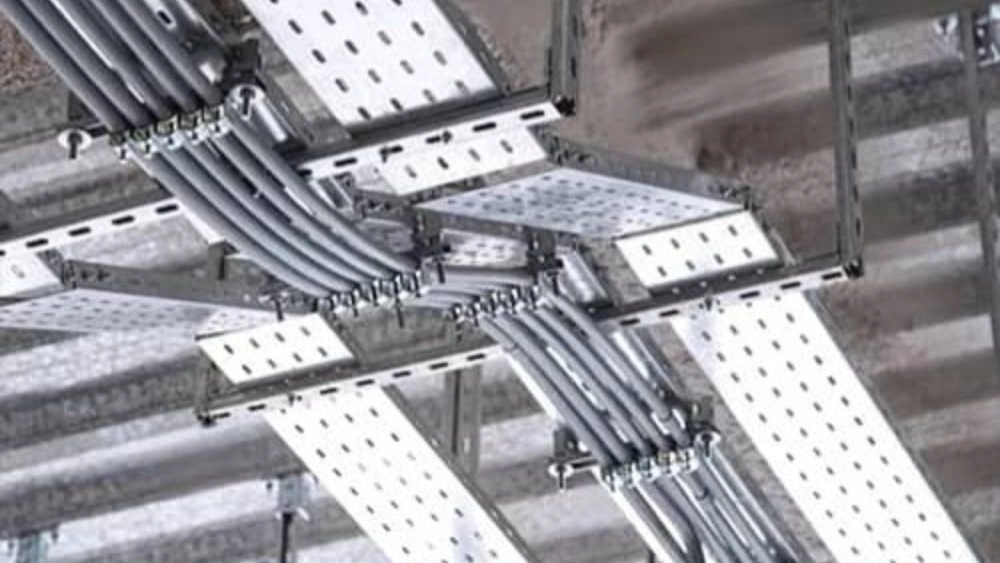
In modern industries and power distribution systems, the correct management of cables is one of the constant challenges of engineers and technicians. Protecting cables against environmental and physical factors, ensuring the safety of personnel and increasing the life of electrical systems, requires the use of equipment known as the backbone of the cabling route. Cable trays alone cannot form a complete and integrated system; Rather, the role of cable tray connections is vital in this. Cable tray connectors are parts that create a strong and safe path by connecting different parts of the tray to each other and connecting them to the structure. In this article from the website rollforming-co.com, we are going to carefully examine the types, standards and implementation points related to cable tray connections to introduce you to this vital equipment.
The importance of using cable tray connections in industrial projects
When it comes to buried or exposed cabling systems in industrial environments, power plants and high-rise buildings, cable tray joints are considered as the connecting link of the system. Without quality and standard connectors, even the best cable trays cannot perform optimally. Cable tray connections are responsible for several tasks; including creating mechanical continuity, bearing the weight of cables and resistance to possible vibrations and vibrations.
Using proper cable tray connections has a direct impact on the durability of the entire system. If the cable tray connectors are not selected and installed correctly, they may lead to the tray falling, damage to the insulation of the cables and even electrical accidents. Leading companies like rollforming-co.com strive to ensure the safety and productivity of projects by producing high quality cable tray fittings. Therefore, a detailed knowledge of these parts and how to use them is essential for engineers and contractors.
Common types of cable tray connectors
The world of cable tray connections is very wide and there is a high variety in the design and application of these parts. Choosing the right type of cable tray connectors depends on the type of project, the installation environment and the load of the cables. In the following, we will discuss the most important types of these connections.
Cable tray connector (Coupler)
One of the most widely used types of cable tray connections is the connector or coupler. This piece has the task of connecting two cable tray branches in the same direction. The cable tray connector is usually designed as one piece or two pieces and is connected to the edges of the tray using bolts and nuts. Using a standard cable tray connector ensures that the two tray plugs are perfectly aligned and that there are no sharp edges at the junction that may damage the cables. In the products of rollforming-co.com, the cable tray connector is manufactured with high precision and from quality galvanized sheet to have the necessary resistance against corrosion.
Inner and outer knee (Elbow)
In cable routes, it is not always possible to move in a straight line and sometimes it is necessary to change direction. Here, the role of elbow type cable tray connections is highlighted. Elbows are produced in two internal (Inward) and external (Outward) models. The inside elbow is used to change the direction towards the inside of the corner and the outside elbow is used to change the direction towards the outside of the corner. These cable tray connectors are designed to provide a standard bend radius for the cables to pass through so that the cables are not damaged by sharp bends. Choosing the right elbow as one of the most vital connections of the cable tray has a great impact on the clean and professional implementation of the installation.
Tee & Cross
For branching from the main path of the cable tray, three-way and four-way cable tray connections are used. Tee is used when a secondary route branches off from the main route, while Cross is used to divide the route into four different directions. These cable tray connectors must have high mechanical resistance because they usually play the role of connecting several tray branches and bear more load. The use of high-quality cable tray connections at the branching points prevents the tray from falling and creating concentrated pressure on the cables.
Conversion fittings (Reducer)
Sometimes it is necessary to transfer from a tray with a certain width to a tray with another width. In this situation, adapter cable tray connectors or reducers are used. This piece has two parallel edges, one of which is connected to the width of the main tray and the other to the width of the secondary tray. The connection of the conversion cable tray allows the width to be changed gradually without creating a sharp edge. This type of cable tray connections is widely used in routes where the number of cables is increased or decreased.
Cable tray connections for changing the level (risers)
In multi-story buildings, cables must be moved from one floor to another. For this purpose, vertical cable tray connections or risers are used. These cable tray connectors allow cables to pass vertically and usually have a cover or guard to prevent objects from falling onto the cables. Safety is critical at these points and the cable tray connectors must be installed in such a way that they can support the weight of the vertical trays.
Construction and material standards for cable tray joints
The quality and durability of cable tray connections are highly dependent on the material used and compliance with international standards. Cable tray joints are usually made of hot or cold galvanized steel sheets. Sheet thickness is very important in making cable tray connections; Because these parts are the points of connection and concentration of stress and must have enough thickness to bear the load.
The IEC 61537 standard is one of the most important references in the design and construction of cable trays and cable tray connections. This standard refers to mechanical and electrical characteristics. Also, in wet or corrosive environments, it is necessary to use cable tray connectors with special coatings such as hot-dip galvanized or stainless steel. The rollforming-co.com company produces cable tray connectors that have a long lifespan and reduce the need for frequent repairs by strictly following these standards. Choosing the right material for cable tray connections guarantees the safety and stability of the system in the long term.
How to install and implement cable tray connections
Correct installation of cable tray connections is as important as the quality of the parts themselves. Even the best cable tray connectors will not perform optimally if they are not installed according to technical principles. In the installation phase, the exact location of each cable tray connection must be determined first. For example, the distance between brackets should be determined according to load calculations.
When installing the cable tray connections, you should use the appropriate bolts and nuts and spring washers so that the connections do not loosen due to vibration. Also, in the place where two branches of the tray are connected using a coupler, screws should be used on both edges of the tray to create a rigid and strong connection. In places where elbow or three-way cable tray connections are used, single or double support brackets must be used near the connection to support the weight of the connection and the load of the cables. Observing these points in the installation of cable tray connections prevents the creation of weak points in the system.
Benefits of using rollforming-co.com quality cable tray connectors
Choosing the right supplier for the purchase of cable tray fittings is half of the success of the project. rollforming-co.com offers products that have the highest level of quality with years of experience in the field of manufacturing industrial profiles and cable tray fittings. One of the main advantages of the cable tray connections produced by this company is the precision in dimensions and sizes, which makes the installation quick and easy.
Also, the rollforming-co.com cable tray connectors have a galvanized coating of the proper thickness, providing excellent corrosion resistance. The variety of products in this company includes all types of cable tray fittings, including coupler, elbow, three-way, four-way and conversion, which covers the needs of different projects. By purchasing cable tray fittings from rollforming-co.com, you will be comfortable with the standard parts and their compatibility with cable trays.
Safety tips when working with cable tray connectors
Safety is always the first priority in electrical and industrial work. When working with cable tray connections, safety precautions are mandatory. First, before starting the installation, make sure that the power is off. Workers should wear safety gloves so as not to get cut when working with the edges of cable tray connections.
Also, when lifting trays and cable tray connections to a height, proper lifting equipment should be used and cable tray connections should not be overloaded. Periodic inspection of the cable tray connections after installation is also necessary so that corrective measures can be taken in time if the screws are loose or if any corrosion is observed in the cable tray connections. These inspections increase the lifespan of the system and prevent accidents.
The difference between cable tray and cable ladder connections
Many users confuse cable tray connectors with cable ladder connectors. Although the usage of both is similar, they have different structure. Cable tray connectors are typically used for slatted or mesh trays that provide a flat surface for cables to sit on. In contrast, cable ladder joints are designed for ladder systems that have parallel rungs.
The shape of cable tray connections is different from ladder connections; For example, the cable tray coupler covers the entire surface of the edge, while the ladder coupler may only connect at certain points. When buying, you should make sure that the cable tray connectors are selected according to the type of tray (slat or ladder). Using improper connectors can cause the trays to be misaligned and put pressure on the cables. At rollforming-co.com, consultants can guide you in choosing the right cable tray connectors for your system.
Maintenance and repairs of cable tray connections
Cabling systems require maintenance after installation. Cable tray connections should be inspected regularly due to their role as connectors. Moisture and dust can cause corrosion of the bolts and nuts in the cable tray connections. Therefore, periodic cleaning and checking the condition of the galvanized coating of the cable tray joints is very important.
If you notice any damage to the cable tray connections, such as cracking or severe corrosion, the part should be replaced immediately. Timely replacement of cable tray connections prevents the spread of damage to other parts of the system. Also, in environments with large temperature changes, cable tray connections may loosen due to expansion and contraction, which requires re-tightening of screws. Planning for preventive maintenance will reduce the cost of heavy repairs in the future.
Buy cable tray fittings online from rollforming-co.com
With the advancement of technology, the purchase of industrial equipment is going online. You can visit the website rollforming-co.com to view the price list and technical specifications of all types of cable tray fittings. Buying directly from the factory eliminates middlemen and reduces the costs of your project.
At rollforming-co.com, all products including cable tray connectors are offered with quality guarantee. The sales experts of this company are ready to answer your questions regarding the selection, installation and price of cable tray connectors. By choosing rollforming-co.com, you choose a reliable business partner for your cabling equipment supply, who is always by your side to get the best results in your projects.
Conclusion: the necessity of choosing the right cable tray connectors
Finally, it can be said that cable tray connections are a small but effective detail in power distribution systems. Choosing the right type, complying with installation standards and using high-quality materials in the construction of cable tray connections, guarantees the safety and stability of your electrical system. Both in huge industrial projects and in residential buildings, the role of cable tray connections is undeniable.
The company rollforming-co.com, with its commitment to quality and standard, is the best option for supplying the cable tray connectors you need. We hope this article has provided you with useful information on cable tray connections. For more information and free consultation, you can always contact our expert team at rollforming-co.com.